
‘That’s my place to be’: Miami student’s predoctoral fellowship aids in cardiovascular research
Ben Akande received two-year fellowship from American Heart Association
‘That’s my place to be’: Miami student’s predoctoral fellowship aids in cardiovascular research
Ben Akande received two-year fellowship from American Heart Association
Growing up in Ghana, West Africa, Ben Akande had to abide by one rule regarding television: You can watch as much as you want, but at 7 p.m., you watch the news.
Akande’s father wanted to ensure that his family was informed and knew what was going on in their community. On one evening news report, Akande saw the story of a crowd-funding effort for an 18-year-old with a “hole in heart” condition, also known as congenital heart defect.
The story made a lasting impression on Akande, one he didn’t fully realize until later in life. Now a Ph.D. candidate in Biology at Miami University, Akande’s innovative research in cardiovascular development is supported with a prestigious predoctoral fellowship from the American Heart Association (AHA).
He is believed to be the first Miami student to earn this distinction, according to Jennifer Schumacher, associate professor of Biology.
“As a researcher, it means a lot,” Akande said of the AHA fellowship, which lasts for two years. “It tells me that what I’m doing is credible and has a real impact on society.”
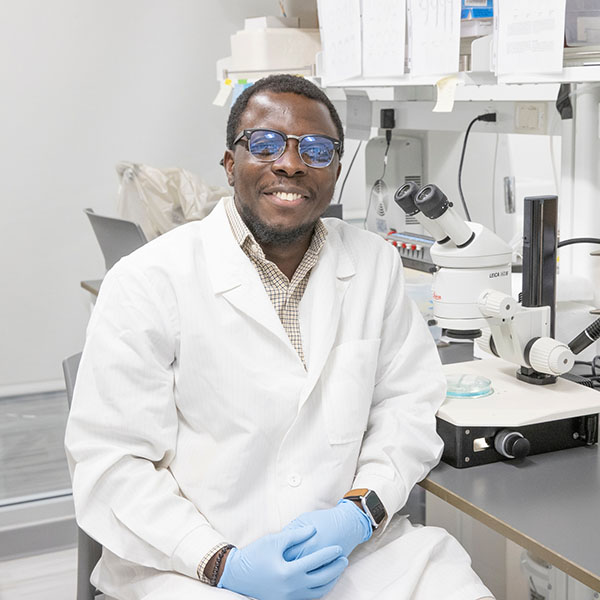
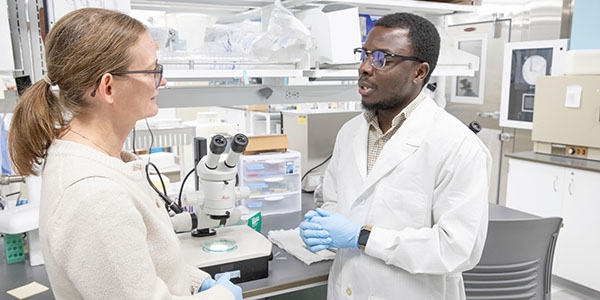
Akande works in Schumacher’s lab, and their focus is on understanding congenital heart defects, particularly in infants, and how molecular pathways influence normal development and disease progression.
As part of this research, Akande studies zebrafish, a freshwater fish with nearly transparent embryos and very similar genes to humans.
“You can visually see in the embryo if something is wrong with the heart,” Schumacher said. “They develop really fast, and you can get answers to these questions quickly. Ben’s project is particularly unique in that it’s investigating a mutation in a gene not connected to congenital heart defects. Hopefully it gives us new and important insights and avenues for investigation.”
Schumacher praised Akande for his creativity, along with the engaging way he talks about his research. He’s also taken on a leadership role in the lab and demonstrated strong written communication.
“This kind of experience really sets him up for future success in managing people,” Schumacher said. “He’s worked with all kinds of personalities. They all love him. He’s a wonderful mentor. He has a way of making people feel comfortable and at ease. It’s really fun working with him.”
Following graduation from the University of Cape Coast, Akande spent a year serving Ghana as a teacher and research assistant in the Department of Biochemistry at the same university. He continued to develop an interest in biology, though. And, as Akande puts it, he “fell in love with the human heart.”
That led Akande to Miami in 2022. Not only was it his first time in the United States, but it was his first time outside of Ghana.
“For me, it was the research and the person who I was going to work with,” Akande said of choosing Miami. “I interviewed at a lot of places, but I knew this was the place for me. I knew if I could work with Dr. Schumacher, I could go far in my career. I can’t explain how I knew it, but I knew it. That’s my place to be.”
At Miami, Akande found a school where faculty members are receptive to student ideas and a supportive environment in Schumacher’s lab. Since coming to Miami, Akande has yet to travel back to Ghana, though he stays in contact through FaceTime calls with his family.
Miami has been overwhelmingly welcoming, Akande said. As a member of the Miami University Association of Ghanaian Students, he hopes to help others find their way, too.
“I tried to find my community,” Akande said. “We want other students to find their place.”
Long term, Akande hopes to become an independent researcher with his own lab to explore cardiovascular diseases. Short term, he has a vision of a postdoctoral fellowship to build up his academic portfolio.
He has received more indications along the way that he is on the right path.
“When I moved to the U.S., I got a notification from a friend in Ghana that a student I had mentored had been diagnosed with a hole in their heart,” Akande said. “This was a sign to me to be in this field. I am going to work toward this, and I am going to find a lasting cure.”
According to Schumacher, Akande’s AHA fellowship is a testament to his scientific skill.
“These fellowships are really competitive. He’s a really strong student,” Schumacher said. “This speaks to the growing strength of Miami from a cardiovascular research point of view, as well as for developmental biology. As we have more students who receive this kind of award, it shows the training they’re getting at Miami is really strong and sets them up for future success in whatever pathway in science they want to take.”