
Student-athlete Sophia Penegor: ‘Don’t be afraid to make the jump’ into undergraduate research
The senior Psychology and Spanish double major works in Elizabeth Kiel’s BEAR Lab, where researchers study parent-child emotional influence
Student-athlete Sophia Penegor: ‘Don’t be afraid to make the jump’ into undergraduate research
The senior Psychology and Spanish double major works in Elizabeth Kiel’s BEAR Lab, where researchers study parent-child emotional influence
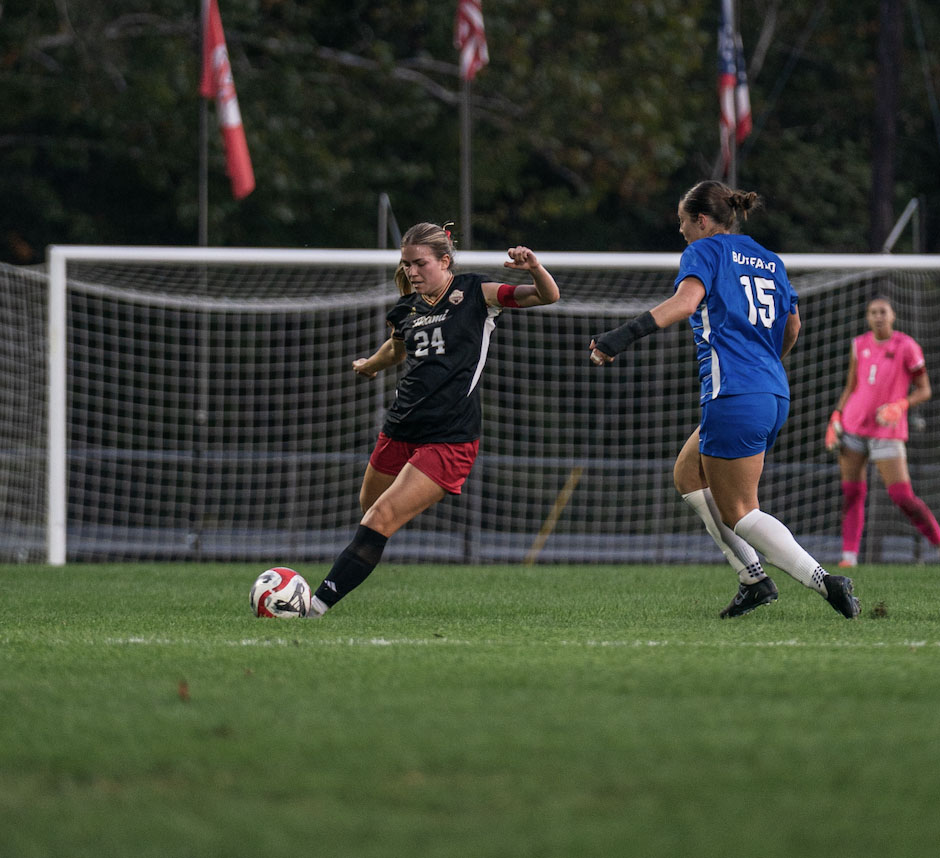
Sophia Penegor’s schedule was jam-packed between classes and soccer season. Undergraduate research was not on her mind. Then she tore her ACL during the fall semester of her first year. Sidelined from soccer, she went looking for a new way to spend her time and found herself in a psychology lab.
Now a senior, Penegor is a double major in Psychology and Spanish with a Premedical and Pre-Health Studies co-major, and a member of Miami University’s women’s soccer team. For her senior honors thesis, she is analyzing data collected from 200 families to identify individual differences in how children’s brains process emotional information and how that correlates with behavior in socially stressful situations such as giving a speech to people they haven’t met. Her findings could help with the design of mental health interventions for anxiety and other emotional regulation difficulties in young children before these issues become more serious.
“Knowing that injury was going to last me through a good majority of my sophomore year, that’s when I started thinking about how I can redistribute my time and find a sense of purpose in something else,” Penegor said. “I’m a person who likes to be doing things pretty much all hours of the day.”
Initially, she majored in Biology but made the switch to Psychology when she realized it interested her more and would allow her to continue her path into healthcare. Then, after attending the Psychology Open House in the fall of her sophomore year, she reached out to a few professors via email about joining their labs; professor of Psychology Elizabeth Kiel being one of them. When they met in person to talk more about the lab, Penegor said the face-to-face aspect of working directly with moms and their children really spoke to her.
The pull was also personal. “This was interesting to me because growing up, I was more on the socially anxious side,” Penegor said. “Also, going to med school, I thought this would really bridge the gap between psychology and neuroscience.”
Penegor has been working in Kiel's lab since the spring of her sophomore year.
Penegor’s thesis uses data from the Transactional Emotional Development in Dyadic Interactions (TEDDI) study in Kiel’s Behavior, Emotions, and Relationships (BEAR) Lab. The study examines how children and parents influence each other’s emotions and what occurs when either experiences significant levels of anxiety, starting in infancy and recording interactions into later childhood.
Researchers use electroencephalogram (EEG) and biological markers as predictors of children’s behavior in socially stressful environments. The EEG records the brain’s electrical activity when subjects are shown photos that may be emotionally evocative (a spider on someone’s shoulder, a funeral procession, or people enjoying a picnic) and again when they are asked to view the same photos from a less emotional angle. Penegor’s thesis is still in its early stages but will be ready for review by spring 2027.
Kiel said she looks for a particular kind of student when people ask to join the lab. “I look for folks who will add to that positive sense of community,” she said. “Everything works better when people trust that they’re working together toward a common goal, that there’s not a competition for resources, that it is a group effort. I want to bring people into the lab who want that type of work environment and will contribute to it.”
Being in the lab, Penegor said, has prepared her to work with “all different types of people,” something she expects to benefit her professionally and personally.
Juggling it all takes planning. Time management is the most difficult aspect of undergraduate research, but Penegor has found ways to make it easier. She schedules all of her lab hours in her Google Calendar, and when she can’t physically be in the lab, she makes up the time at home or after soccer season ends in mid-November. For student-athletes, she recommends being open and honest with principal investigators and professors about time restrictions and choosing labs that allow for flexibility in schedule.
She acknowledges that taking the leap into undergraduate research can be scary, but she said it’s worth doing for students who are genuinely interested.
“Don’t be afraid to make the jump,” Penegor said. “If it’s too much, you can always say so and take a step back.”