
Miami University’s new DNA sequencer opens doors for student researchers
Lyla Vivian and Katarina Teasdale are among the first students to use the cutting-edge PacBio Vega Benchtop System
•
Published
•
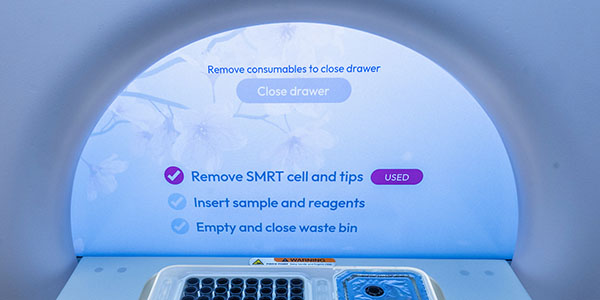
A close-up of the PacBio Vega Benchtop System in use.
Miami University’s new DNA sequencer opens doors for student researchers
Lyla Vivian and Katarina Teasdale are among the first students to use the cutting-edge PacBio Vega Benchtop System
•
Published
•
In 2025, Miami University acquired a cutting-edge DNA sequencer, one of the first in the Midwest. Now, two students are using this new instrument to conduct research that would have taken far longer without it.
As part of their research endeavors, Katarina Teasdale, a junior majoring in Biology, and Lyla Vivian, a Microbiology master’s student working with Mitch Balish, professor of Microbiology, used the PacBio Vega Benchtop System. The Vega system uses Hifi long-read sequencing technology to sequence larger DNA fragments, reducing wait times for results to a few days compared to short-read sequencers, which can take weeks.
Vivian’s work on “Heterogeneous cell shapes during mycoplasma growth and division” studies the cell shapes of highly contagious bacteria that infect walruses, cows, and pigs. The mycoplasma Vivian is working with has also never been sequenced before.
“They’re special from normal bacteria because they have no cell wall, so they can make really funky shapes where usually bacteria is restricted to certain shapes,” Vivian explained.
She wants to see what is allowing these bacteria to make unusual shapes and how it correlates with cell growth speed. Learning how these bacteria replicate can help researchers understand the mechanisms behind bacterial replication. Moreover, this knowledge could also lead to the creation of therapeutics that help prevent the spread of bacteria on farms, where diseased animals can impact the agricultural industry. Publishing that DNA sequence will also allow other scientists to reference and compare strains for their own research.
As part of their research endeavors, Katarina Teasdale, a junior majoring in Biology, and Lyla Vivian, a Microbiology master’s student working with Mitch Balish, professor of Microbiology, used the PacBio Vega Benchtop System. The Vega system uses Hifi long-read sequencing technology to sequence larger DNA fragments, reducing wait times for results to a few days compared to short-read sequencers, which can take weeks.
Vivian’s work on “Heterogeneous cell shapes during mycoplasma growth and division” studies the cell shapes of highly contagious bacteria that infect walruses, cows, and pigs. The mycoplasma Vivian is working with has also never been sequenced before.
“They’re special from normal bacteria because they have no cell wall, so they can make really funky shapes where usually bacteria is restricted to certain shapes,” Vivian explained.
She wants to see what is allowing these bacteria to make unusual shapes and how it correlates with cell growth speed. Learning how these bacteria replicate can help researchers understand the mechanisms behind bacterial replication. Moreover, this knowledge could also lead to the creation of therapeutics that help prevent the spread of bacteria on farms, where diseased animals can impact the agricultural industry. Publishing that DNA sequence will also allow other scientists to reference and compare strains for their own research.
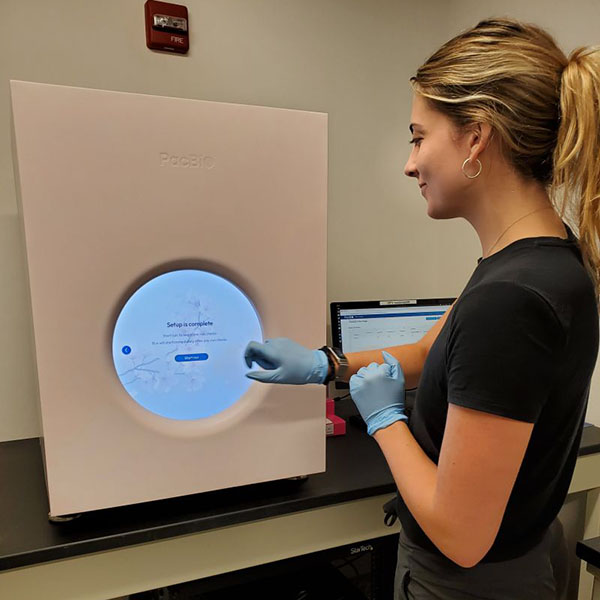
Lyla Vivian uses the Vega instrument for the first time for her research.
“Cataracts form when the crystallin proteins inside a lens become denatured, or unstable. When this happens, they make the lens cloudy, and that’s why you can’t see out of it anymore,” Teasdale said.
Caimans represent a basal taxon, which means they are an “old” species, having evolved very early on. This makes them a great model organism to study lens crystallins, as lens crystallins are highly conserved, meaning that their DNA sequences have not changed much over time, so any unique variants or isoforms present might be able to provide insight into lens crystallin stability. Teasdale can contrast the caimans’ genetic information with that of other animals whose DNA allows for clear lenses. Understanding their structure could lead to the development of a treatment or medication to delay the onset of cataracts.
Teasdale is now working on building a phylogenetic evolutionary tree to map the protein variants of the eye lenses to see how they changed over time and how that has impacted their structure.
For both Vivian and Teasdale, the Vega proved to be a significant advantage in time and cost. Vivian completed her sequencing within a week — a process that would have taken several weeks and multiple runs on other instruments. Teasdale, working in the lab just once a week, finished within a semester, but estimates she could have done it in a week had she, too, been sequencing continuously.
“If I had to use something that was a lot more expensive, I don’t know if I would have the same opportunity to do this specific experiment,” Vivian said.
Vivian and Teasdale also mentioned how easy it was to be trained to use the Vega for their work. Teasdale specifically noted how accessible the Vega was as someone who hadn’t used an instrument like that before.
“With the right guidance, I think anyone could do it,” Teasdale said. “It’s daunting because it’s a big machine, but the Vega is actually really user-friendly.” Further reflecting on her experience, Teasdale said “Working with cutting-edge technology teaches you to not only trust the skills you currently have, but trust that you will be able to learn and pick up the skills that you need.”
Teasdale credits her start and continued interest in research from meeting Kiss at the Undergraduate Research Forum (URF) her freshman year. She approached his table for the Center of Bioinformatics & Functional Genomics, for which Kiss is the director, and he asked if she was interested in working on a project. After an exchange of emails, their mentor relationship developed from there. For students interested in pursuing research, it’s not as intimidating as one might think, and Teasdale encourages students to reach out to professors they’re interested in working with.
“Miami is really good at connecting undergrads with research opportunities. If you want it, you can go find it,” Teasdale said.
Established in 1809, Miami University is located in Oxford, Ohio, with regional campuses in Hamilton and Middletown, a learning center in West Chester, and a European study center in Luxembourg. Interested in learning more about the Center of Bioinformatics and Functional Genomics? Visit the website for more information.