
Two Theatre alumnae who have collaborated for 20 years will present latest project at Lincoln Center for the Performing Arts
‘there are no dead people’ blurs the boundaries of theater and performance art
Two Theatre alumnae who have collaborated for 20 years will present latest project at Lincoln Center for the Performing Arts
‘there are no dead people’ blurs the boundaries of theater and performance art
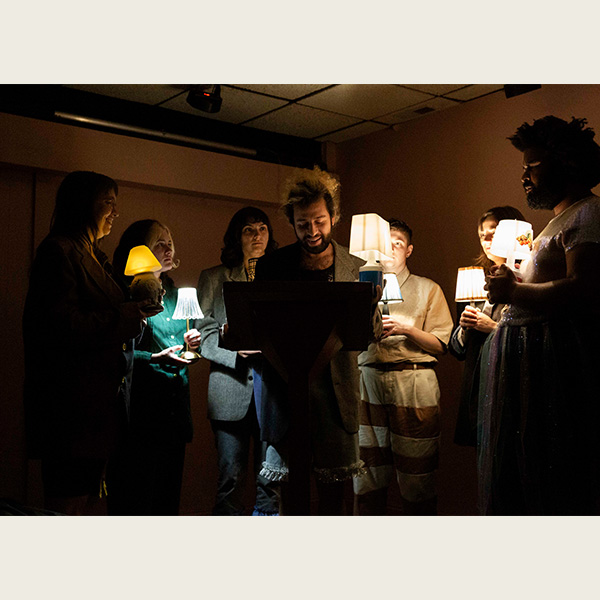
Two Miami University alumnae who have been collaborating since their days on campus will present their latest project in February as part of the Lincoln Center Presents series.
Amanda Dunne Acevedo ’06 and Lindsey Barlag Thornton ’06 established their Chicago-based artistic partnership, Genesis, to create performances that intentionally consider space and audience. They have collaborated for 20 years, and their latest project, "there are no dead people," will have its New York premiere on Feb. 27.
“As Genesis, we create performances that are not one story but collections of stories, rituals, and memories,” Thornton said. “The performance is a gift we offer an audience to experience and create their own meaning. Our goal with each performance is to make the audience feel alive, aware of themselves, each other, and the space they share with the performance.”
They developed the performance after Acevedo had a thought in May 2021 when her daughter was 5 months old.
“I sent Lindsey a voice memo telling her that I had this idea that was about all the things I would want her to tell my daughter if I died,” she said. “The idea was partially in earnest and partially about an artwork we could create — ‘if I die,’ which was the working title for the piece for quite a while.”
Acevedo continued, “That message kicked off a conversation and artistic exploration between us about grief, and not just the grief that comes from death, but all the little griefs we experience throughout our lifetime. And ultimately, what keeps us going.”
The project involved devising, a process of creating a performance piece with collaborators using improvisation and other methods.
Thornton said that in their devising process for “there are no dead people,” they found themselves deep in contemplation of death and grief.
“We asked how we might hold one another through sorrow, how care can become a collective act, and how, even in the presence of loss, joy might still be possible. Through personal stories and celebration, we invite the audience to reflect on their own lives and their relationship to death.”
Ann Elizabeth Armstrong, associate professor of Theatre in Miami’s College of Creative Arts, saw an early version of the piece they will present at Lincoln Center.
“It was a fantastic and intimate experience,” she said. “They use movement and audience participation to create a sense of communion and it is very touching and honest.”
Miami days
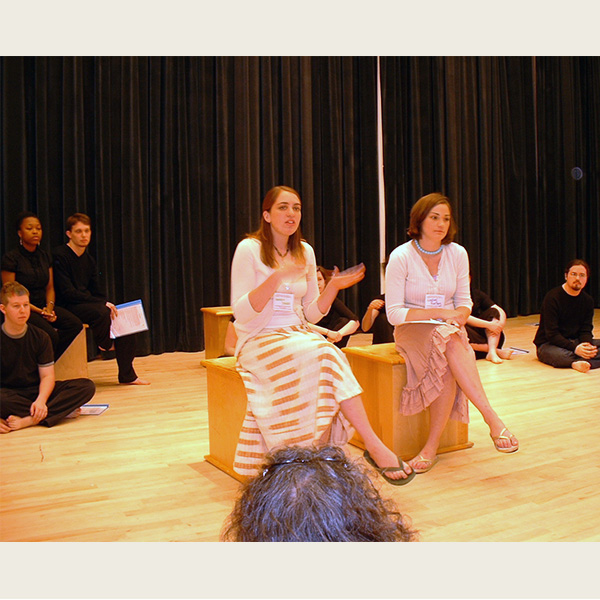
Armstrong remembers working with the women when they were students who co-founded in 2004 the Walking Theatre Project (WTP), a social justice and activism theater company that continues on campus today.
Back then, they wondered how they could use their art and artistry to address some of the inequities and injustices they saw in the world.
Acevedo, who graduated from Miami with a bachelor’s in Theatre and Arts Administration and earned a Master of Education in Arts in Education from Harvard in 2018, said Armstrong was one of the professors who “planted the idea that we could think more expansively about art, beyond the stage.
“And honestly, I am gobsmacked that WTP still exists! It just shows that students want a place to experiment and use their voices in that way.”
Thornton graduated with a bachelor’s in Theatre from Miami. She later earned a Master of Fine Arts in Studio Art: Performance in 2014 from the School of the Art Institute of Chicago, where she was a faculty lecturer until 2024.
Thornton said the Walking Theatre Project developed in the wake of the 2004 election, and several states had just passed amendments banning same-sex marriage.
“A high school classmate of mine had recently died fighting in the war. I remember we were angry; we were frustrated with our country, our leaders, and our institutions.”
She continued, “I also remember an infectious optimism and a belief that change was necessary and possible. Ann Elizabeth Armstrong and Norma Bowles from Fringe Benefits theater company (a guest artist who co-edited their "A More Perfect Union" play) introduced us to theories and tools for making social justice theater. They gave us the framework and language to transform our anger and hope into meaningful work and community action.”
With the Walking Theatre Project, they staged more than 20 public performances of "A More Perfect Union" on Miami’s campus.
“But what stays with me more than the performances themselves are the conversations that followed,” Thornton said. “After each show, we created space for real, vulnerable, often difficult conversations with students, faculty, and community members. It was in those moments of exchange that theater became not just performance but a catalyst for connection.”
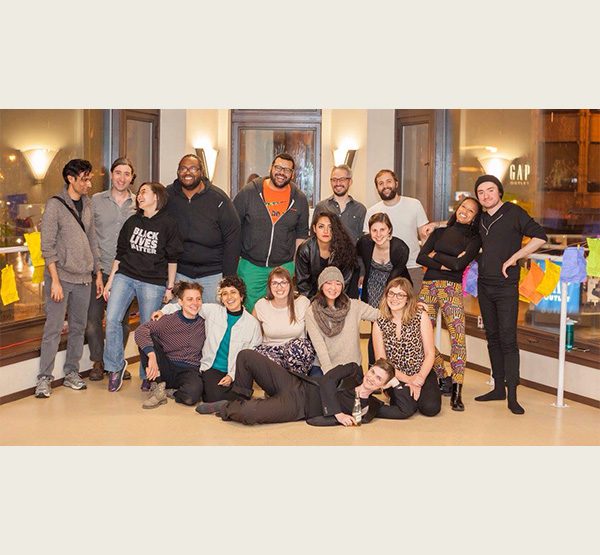
Armstrong watched as both women went on to work for Fringe Benefits and then became teaching artists in Chicago, where they founded Genesis with some of their friends and alumni from Miami and later expanded it to include other artists in the Chicago area.
“Lindsey and Amanda are the leaders of the company, with other collaborators cycling through. They really are a great creative team, and I remember how they really complemented each other's skill set,” Armstrong said. “They have a wonderful way of framing a creative problem and then exploring it together, bouncing ideas off of each other, testing them, and thinking through creative choices.”
Blurring the boundaries
Thornton said they were fortunate at Miami to have several professors who introduced them to expansive and unconventional ways of making theater.
In 2003, Sally Harrison Pepper from the Western College Program directed a yearlong, devised ensemble performance titled “The Genesis Project.”
“This making process reshaped our idea of what theater could be and gifted us our name. This experience grounded our commitment to collaborative, process-driven creation,” Thornton said. “Later, in our senior capstone class, Roger Bechtel introduced us to a range of experimental theater-makers whose work deeply resonated with us.”
The women said “there are no dead people” blurs the boundaries of live performance, a style of storytelling that appeals to them.
Thornton said, “There is no fourth wall; we are not playing characters but rather performing ourselves while acknowledging and speaking directly to the audience.
“The performance begins with a soft start of waiting and gathering and ends by bleeding into the after-party. Over its duration, we layer the tropes of major life celebrations with the structures of stand-up comedy and memorial services. We play improvisational games recounting moments that create a life: all the firsts, lasts, onlys, beginnings, endings, and transitions,” Thornton said. “We perform dance numbers. We give toasts to the things we do to cope and mend in the wake of grief, to secret pleasures and small joys.”
While it’s a performance, it is also an event, Thornton said.
“It is an experience we invite the audience to take with us. This approach to storytelling and performance makes us feel most excited and alive,” she said. “It allows us to bring our authentic selves to the making, while embracing a process that evolves continually with time, space, collaborators, and audience.”
Then and now
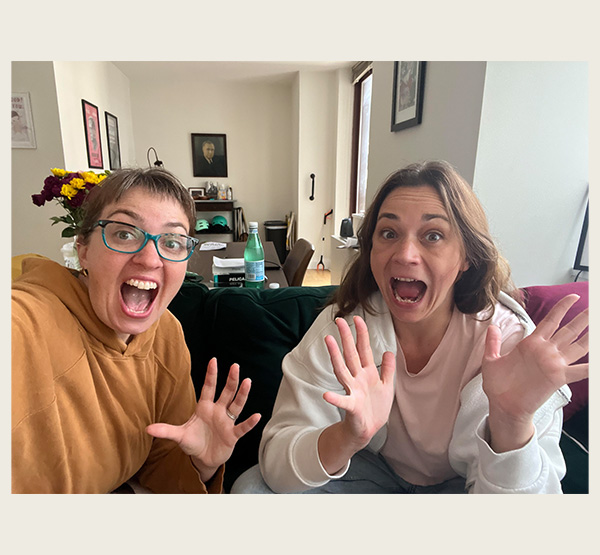
Acevedo remembered that when they were students at Miami, “there seemed to be all these “micro-opportunities” to take theater outside the classroom and find your own voice and style.”
She said Howard Blanning made Presser Hall, pre-renovation, a place for students to stage their own work and play readings in the basement. “Without really knowing it at the time, we started to understand how to utilize the resources we had available to us on campus and not to take for granted the space and technology we had access to.”
Acevedo continued, “This felt vital to developing the type of artistic voices that Lindsey and I have today. Because we were able to take risks, and make mistakes, these experiences were as important as the classes we were taking.
“At the time, those things seemed to work in tandem. I hope students are still taking that initiative and using their undergraduate years as a time to figure out what they might want to be beyond the traditional roles of actor, director, or stage manager.”
Established in 1809, Miami University is located in Oxford, Ohio, with regional campuses in Hamilton and Middletown, a learning center in West Chester, and a European study center in Luxembourg. Interested in learning more about the College of Creative Arts? Visit the website for more information.